Your source for fruit and vegetable news
Latest News Blogs/Links Features Classifieds Home. Farmers Markets. Market News. Recipe Corner. About Us. Garden Photos. Archives.
Click for Windsor, Virginia Forecast
By Bobbie Whitehead

Gardeners have a variety of colors, flavors and sizes from which to choose when it comes to planting onions.

For 2010, some seed companies have announced some new onion varieties like the Red Candy Apple or Red Marble Cipollini Italian, among the many red, white and yellow onions available.

For a colorful salad, the Red Candy Apple, a sweet red, intermediate onion with a four-inch diameter bulb, matures in about 95 days, as noted in the product description at Gurney’s Seed & Nursery in Greendale, Ind.

The Salad Red onion variety typically produces a two-inch diameter bulb at harvest.

Gardeners can find new and favorite onions for planting
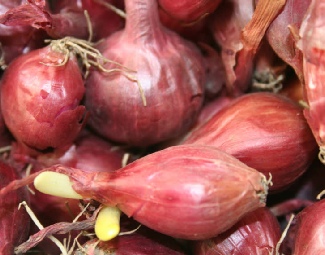
Or perhaps, gardeners might want to try the Red Marble Cipollini Italian onion from Jung Quality Garden Seeds of Randolph, Wis. This particular red is described as having a “pungent flavor and excellent red color throughout,” as noted in the Jung product description. The Red Marble Cipollini Italian, a long-day variety, is said to mature in 95-100 days.

Though growing from seed might not be an option now in warmer regions as April approaches, gardeners in these areas can still plant onions with onion set (small bulbs an inch or smaller in diameter) or transplants.

In Virginia, for example, transplants and onion set can be planted March 20 through April 1, according to the Virginia Cooperative Extension. A week or two after that date can work if the season has been cooler than normal. Growers further north have a little more time, though.

Whether planting from seed, sets or transplants, onions require an area with full sun and loose soil that has drainage. Soil with a significant amount of clay can stunt bulb growth or cause a flat or odd shape.

Gardeners also want to choose the onion variety - short day (best for fall planting), long day (appropriate for northern regions with longer summer days) or intermediate day (appropriate for most regions’ daylight hours except far northern and southern regions) – best for their growing area.

Before planting, gardeners can prepare the soil with fertilizer such as 10-10-10. Extension Specialists Diane Relf and Alan McDaniel of Virginia Tech write in their article “Onions, Garlic, and Shallots” that three pounds of 10-10-10 for each 100 square feet is adequate, and they suggest using a starter solution for transplants. If the onions need additional fertilizing, gardeners can sidedress the rows later, Relf and McDaniel write.

After soil preparation, the onion sets should be planted about an inch deep and about two-four inches apart, depending on the size of the bulb (more space the larger the bulb), according to Cornell University’s Vegetable Growing Guide for onions. Relf and McDaniel write that rows should be about one-two feet apart.

In caring for the onions, growers should keep the weeds pulled and can place mulch around the rows to keep weeds to a minimum as well as hold in moisture since onions require water. Once the plants sprout and continue to grow, spring-planted bulb onions can be harvested in about 60-80 days, depending on the variety.

For more detailed onion-growing guides, a map to determine what type of onions to grow in each region or to buy onion varieties, visit Dixondale Farms of Texas, http://www.dixondalefarms.com, and the new varieties listed for 2010 can be found at the following seed companies:

1. http://www.jungseed.com
2. http://www.gurneys.com
FREE GAME - Text Twist 2
Your Ad Here