Your source for fruit and vegetable news
Copyright © 2008-2010 by thebackyardgrower.com  All rights reserved.  Terms of use | Privacy policy
Home.Farmers Markets.Market News.Recipe Corner.About Us.Garden Photos.Archives.

FEATURES

GARDEN TIPS

BLOG/LINKS

LATEST NEWS

CLASSIFIEDS

Your Ad Here
By Bobbie Whitehead

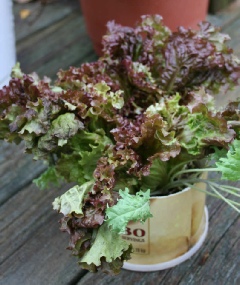
Leaf lettuces, whether green or red, can grow in the fall and winter with a little care to protect against freezing temperatures.

Some gardeners and growers selling leaf lettuce at farmers markets and roadside stands grow arugula, Mesclun mix, mustard, Bibb and romaine lettuces into the winter with the help of row covers. Since lettuce is a cool season crop, it can handle light frost and cool temperatures as long as young plants have adjusted to the temperatures.

Even growing lettuce crops successively in a small greenhouse or in containers indoors will keep the harvests coming through most of the winter.

Plant successive lettuce crops for continued winter harvests

A cool season crop, lettuce can keep harvests coming throughout a season with subsequent plantings.
Save 10% now.

Use coupon code “Grower10.”

Gardeners can grow lettuce from either seeds or transplants – some, though, prefer using seeds since they’re more cost-effective.

To start with, make sure the soil is loose. For growers and gardeners uncertain about their soil’s needs, have a soil test done ahead of time at a local agricultural extension office. (Click here for information on soil testing.)

“If the soil potassium and phosphorous level is high, 2 pounds per 100 square feet of 10-10-10 should be adequate,” writes Douglas Sanders, extension horticultural specialist with North Carolina State University, in the article “Home Garden Lettuce.”

Before planting the lettuce, rake half of the fertilizer into the soil, Sanders writes, and add the second half of the fertilizer as a side dressing after the planting the seeds. Shortly after the plants have sprouted, growers and gardeners can add a second side dressing of fertilizer.

Then, sow seeds about 1/4-inch deep. Some growers say there’s little need for spacing leaf lettuces such as arugula, and others suggest spacing the leaf lettuces one or more inches apart. For romaine, space the plants four-to-six inches apart, and for butterhead, space the plants at least 12 inches apart.

Rows for all the lettuces should be about 12-to-24 inches apart, writes Diane Relf retired Extension Specialist of Environmental Horticulture and Alan McDaniel, Extension Specialist of Horticulture at Virginia Tech in their article “Leafy Green Vegetables.”

Relf and McDaniel explain that lettuce is a medium-heavy feeder, which means the plant uses a number of nutrients from the soil and suggest using a starter solution on transplants. Starter solutions, they write in the article “Fertilizing the Vegetable Garden,” “satisfy the need for phosphorus.” If deficiencies are noted in the plants once they begin growing, Relf and McDaniel suggest adding a side dressing of fertilizer.

Since leaf lettuces grow quickly, some growers suggest following each lettuce crop with a subsequent planting to keep the harvest supplies coming throughout a season. For example, some varieties of arugula will sprout a few days after their planted and can be harvested when they’ve reached about five inches in 30-50 days.