Your source for fruit and vegetable news
Copyright © 2008-2010 by thebackyardgrower.com  All rights reserved.  Terms of use | Privacy policy
Home.Farmers Markets.Market News.Recipe Corner.About Us.Classifieds.Archives.

FEATURES

GARDEN TIPS

DISHES BLOG

LATEST NEWS

LINKS

Your Ad Here
By Bobbie Whitehead

Gardeners and small-acreage growers in Virginia and North Carolina can begin planting spring onions, which are harvested when the onion leaves are as thick as a pencil.

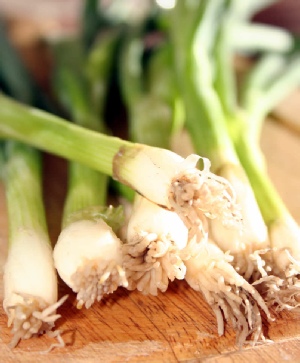
Sold in bunches at farmers markets and roadside stands, spring onions make for a great addition to meals when they’re ready for cutting in the late winter or early spring, whether you’re a home cook or a backyard grower.

Onions rank sixth among vegetables harvested worldwide, according to the Centers for Disease Control and Prevention, and the CDC reports that people recognized the vegetable’s ability to withstand spoilage more than 3,500 years ago, which is why the onion, said to have originated in Asia, became popular.

Spring onions can be planted in three different ways - using seeds, seed set (tiny bulbs about an inch in diameter) or transplants.

Start planning your green or bunching onion crop for spring

Growers and gardeners alike in certain areas, such as Virginia and North Carolina, can start planting spring onions.

Save 10% now.

Use coupon code “Grower10.”

Many retail and independent garden centers will have either of these. You can also order them from the various seed outlets via the Internet or mail order catalogues.

For those who aren’t sure what type to plant now, the Virginia Cooperative Extension suggests that “Egyptian tree or multiplier onions should be set in late October or early November.”

Onions fall into three categories, short-day, long-day and intermediate varieties. Short-day varieties can be planted in the fall and late winter when there are fewer daylight hours. The long-day varieties grow best in northern regions during the warmer months when the daylight hours are longer. Gardeners can also find intermediate varieties, which grow just about anywhere, except the far north and far south. Most seed retailers, local or online, sell the varieties appropriate for a particular region. Knowing the difference between long-day and short-day varieties helps, particularly if gardeners are interested in growing bulb onions.

When planting spring onions, prepare your soil with some fertilizer, 10-10-10, before hand.  “Apply 3 lbs. 10-10-10 per 100 sq. ft. before planting, use starter solution for transplants, and sidedress four to six weeks after planting with 2 lbs. 10-10-10 per 100 sq. feet (repeat four to six weeks later if needed),” writes Diane Relf, Extension Specialist, Environmental Horticulture, and Alan McDaniel, Extension Specialist, Horticulture, both of Virginia Tech, in their article “Onions, Garlic, and Shallots.”  (Onions grow best in loose soil, particularly if you plan to grow bulb onions.)

If you’re planting seeds, plant them about ½-inch deep. Plant seed set and transplants about the same depth and “plant 4 inches apart in rows 1 to 2 feet apart,” the Virginia Cooperative Extension suggests.

The transplants, though, will already have onion leaves sprouted. Both seed set and transplants are best planted late in the winter or early spring in areas like Virginia and North Carolina. Here’s again, the planting dates depend on the climate of the region in which the gardener plans to grow.

For onions sown in the fall or late winter, North Carolina extension specialists with North Carolina State University suggest protecting the onion beds once temperatures drop to 20 degrees (F) or below.

When harvesting spring onions, some growers and gardeners cut the onion leaves when they reach about six inches high, and others suggest pulling the onions when they are 10 inches. Cutting them isn’t necessary, though, since many market sellers sell bunches with the small onion root still attached.

For more information on growing spring onions, particularly specific information by region, the U.S. Department of Agriculture has a web page, click here, which provides a listing of links for home vegetable gardening.