Your source for fruit and vegetable news
Copyright © 2008-2010 by thebackyardgrower.com  All rights reserved.  Terms of use | Privacy policy
Home.Farmers Markets.Market News.Recipe Corner.About Us.Classifieds.Archives.

FEATURES

GARDEN TIPS

DISHES BLOG

LATEST NEWS

LINKS

Your Ad Here
By Bobbie Whitehead

Gardeners interested in planting Cole crops or leafy greens can find fall plants available at area garden centers.

Many centers announced their fall plants’ arrival this week, offering either bare-root or greenhouse-grown transplants. Though some growers plant cabbage each month, others wait until the late summer to put in a fall garden of the Cole crops and leafy greens.

The popular fall crops include cabbage, broccoli, collards and kale, which grow well in the fall temperatures. Some fall crops such as cabbage, collards and kale taste better after a light frost, some growers say.
For planting cabbage, place each plant about 12-18 inches apart in rows that are 30 inches apart in a sunny and well-drained area of the garden, writes Diane Relf, Extension Specialist, Horticulture and Alan McDaniel, Extension Specialist, Horticulture of Virginia Tech in their article “Cole Crops or Brassicas.”

Relf and McDaniel also suggest using a starter fertilizer on the transplants and follow up in three weeks with a side dressing of 30-0-0, which is urea ammonium nitrate, using three tablespoons for each 10-foot row.

If you’re new to fertilizing your garden or field, Relf and McDaniel explain in their article, “Fertilizing the Vegetable Garden,” that a side dressing means placing the fertilizer on each side of the row about six inches away from the plants. Gardeners should then rake the fertilizer into the soil and water, the extension specialists write.

Depending on the variety, and Relf and McDaniel suggest growing only early varieties after July 1, cabbage matures in 60 to 100 days. Even if the weather brings in some frost or cold temperatures before the cabbage is ready, it can withstand temperatures as low at 15 degrees (F), according to the extension specialists.

Broccoli transplants require similar treatment as cabbage, sunny and well-drained soil with more spacing between the plants, about 15-24 inches with rows being 24-36 inches apart, Relf and McDaniel write. Gardeners will also use a starter fertilizer on the transplants as well as following up with side dressing of 30-0-0 at the same interval.

The broccoli matures in about the same amount of time as the cabbage and should be picked before the head flowers begin to open.

Kale and collards, which are considered leafy greens, can also grow through the winter and require similar spacing as cabbage and broccoli with kale needing less space between the plants (10-18 inches) and rows (18-36), according to the extension specialists.

But with these two vegetables, Relf and McDaniel suggest side dressing the plants with 1 ½ ounces of 30-0-0 fertilizer for each 10-foot row. The two are ready to harvest in about 45 days and can grow in cold temperatures. Many area growers use row covers to protect their plants in the cold winter and say that the kale and collards taste sweeter once a mild frost has occurred.

Garden centers now have fall plants: cabbage, broccoli, kale

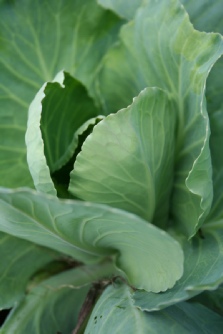
Fall garden plants are available. Cabbage can withstand freezing temperatures. A cabbage, left, planted in September 2008 survived the January freeze this year and continues to grow.


Click here for information on bare root and greenhouse transplants.
Save 10% now.

Use coupon code “Grower10.”