Your source for fruit and vegetable news
Latest News Blogs/Links Features Classifieds Home. Farmers Markets. Market News. Recipe Corner. About Us. Garden Photos. Archives.

Click for Windsor, Virginia Forecast

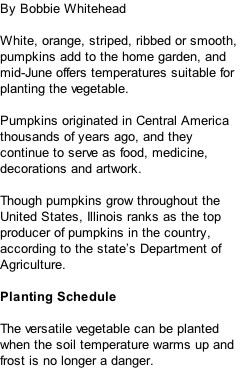
Hijinks F1 Pumpkin, an All-America Selections Winner, is a new painting and carving variety introduced by Sakata Seed America Inc. for 2011 (Photo courtesy of the National Garden Bureau).

Mid-June offers suitable temps for pumpkin planting
By Bobbie Whitehead

White, orange, striped, ribbed or smooth, pumpkins add to the home garden, and mid-June offers temperatures suitable for planting the vegetable.

Pumpkins originated in Central America thousands of years ago, and they continue to serve as food, medicine, decorations and artwork.

Though pumpkins grow throughout the United States, Illinois ranks as the top producer of pumpkins in the country, according to the state’s Department of Agriculture.

Planting Schedule

The versatile vegetable can be planted when the soil temperature warms up and frost is no longer a danger.
The best rule of thumb for pumpkin planting time is to wait until soil has warmed up to about 65-70 degrees, according to Cornell University Cooperative Extension in its growing guide, “Pumpkins.”

Another planting time consideration includes usage of the pumpkin; for gardeners intending to sell their pumpkins at farmers markets or roadside stands, planting as early as possible with regards to temperatures is best to assure pumpkin maturity in time for the holidays.

Sowing Requirements

To start, pumpkins grow well in an area with full sun and loose soil that drains well. Because pumpkins are heavy feeders, they require fertilizing. The Cornell University Cooperative Extension suggests using soil that’s “high in organic matter with pH between 5.8 and 6.8.”

Because pumpkin plant vine grow quite lengthy, they’ll need plenty of space, about 48 inches, writes Larry Bass, North Carolina State University extension agent in the article “Home Vegetable Gardening.”

Depending on the variety and size of pumpkin the vine produces, more spacing may be needed. “If the plants are spaced too closely fruit size may be decreased,” writes Regina Prunty,  Virginia Cooperative Extension agent for King George County, in the article “Consider Pumpkins and Gourds for Fall Harvest Crop Options.”

Prunty suggests these plant and row spacings:

1. Pumpkins 30 pounds or more:  10-12 feet apart, 5-6 between rows.
2. Pumpkins 12-25 pounds: 71/2-9 feet apart, four feet between rows.
3. Pumpkins 8-15 pounds: 6-7 ½ feet apart, 3-4 feet between rows.
4. Pumpkins less than 8 pounds: 5-6 feet apart, two feet between rows.

Nurturing Pumpkins

While waiting to harvest, gardeners do need to assure the plants receive adequate water, especially during dry spells. Also, gardeners need to make sure they keep out the weeds.

Harvest times for pumpkins typically occur 115 to 130 days after planting, though some varieties may ripen sooner. Prunty writes that gardeners should harvest pumpkins before the first frost and check them to make sure they don’t have any injuries, which can lead to diseases and destruction of the pumpkins.

Removing Pests

Pumpkins like other cucurbits (cucumbers, squash and melons) face a number of pests and diseases. Some include aphids, cucumber beetles and squash bugs, and diseases affecting pumpkins include bacterial wilt and powdery mildew.

Cornell University Cooperative Extension suggests watering the plants early in the day, so they’ll dry to avoid mildew and removing and destroying plants affected with bacterial wilt. Also, gardeners can spray off most of the pests such as aphids or hand pick squash bugs. But for cucumber beetles, gardeners can cover the plants with floating row covers – removing the covers as the temperatures rise – to prevent their damage such as bacterial wilt.

Since gardeners will find many different pumpkin colors and sizes, they can contact their local extension offices to determine which varieties grow best in their area.
Your Ad Here